4 months ago
18
4 months ago
18
TL;DR: The setting of a story is the time, place, and social environment in which a narrative takes place. A strong setting does three things: it establishes mood, shapes character behavior, and drives plot. The 8 tips below cover how to choose, research, and write your setting so it pulls readers in, rather than slowing them down. For fictional worlds, there’s an additional section on world-building sequence and map-drawing.
What Most Writers Get Wrong About Setting
Setting is not description. That’s the mistake most writers make.
They pile on atmospheric details at the start of a chapter—the weather, the architecture, the light—and call it setting. Then readers skim it or skip it entirely, and the writer wonders why the world doesn’t feel real.
The truth: setting isn’t something you describe. It’s something you reveal through action, dialogue, and sensory detail woven across the entire narrative. Done right, readers absorb your setting the same way they absorb the real world without noticing it consciously, but feeling it constantly.
This guide gives you the framework to do that: what setting actually is, why it matters, how to choose it, how to research it, and 8 proven tips for writing it in a way that keeps readers inside your story.

Get Our 6″ x 9″ Pre-Formatted Book Template for Word or Mac
We will send you a Book Template for US Trade (standard paperback size).
What Is the Setting of a Story?
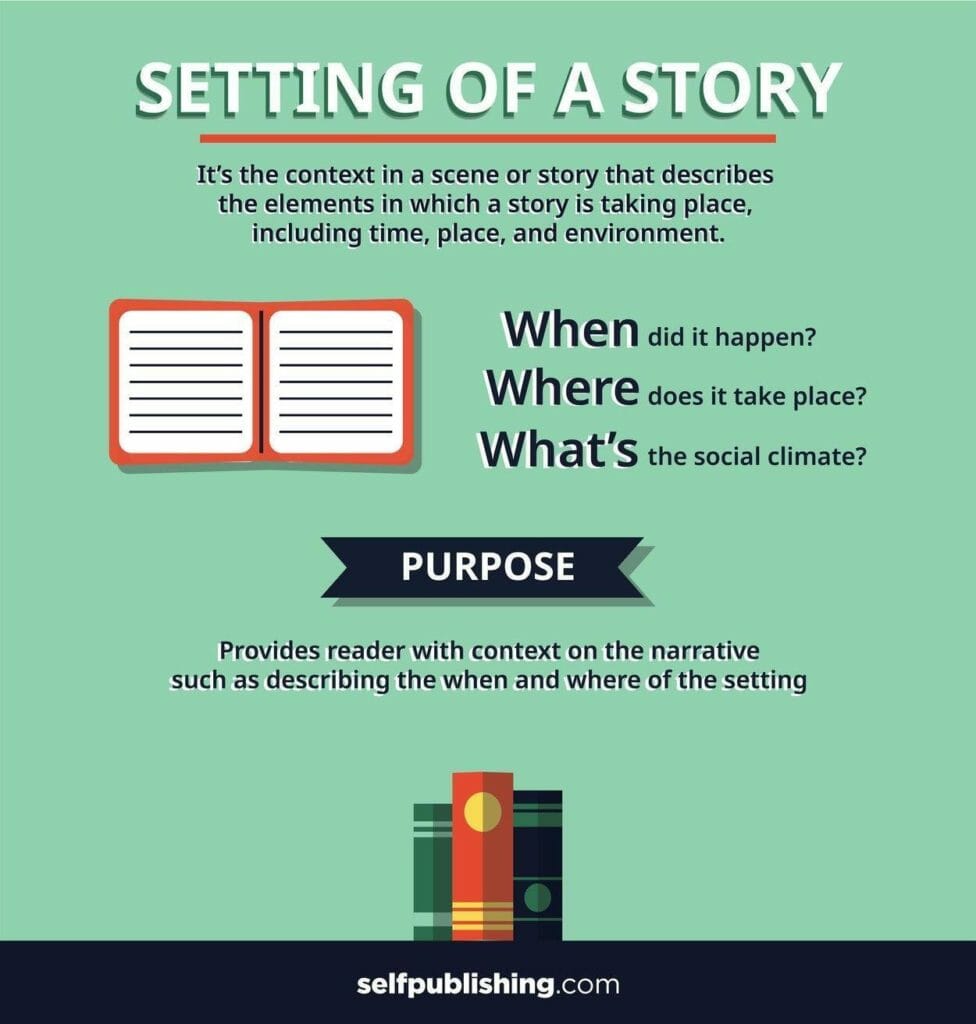
The setting of a story is the context—time, place, and environment—in which a narrative takes place. It includes not just physical location, but also the social, cultural, historical, and atmospheric conditions that shape the story’s world.
Most writers think of setting as a backdrop. It isn’t. Setting is an active force.
It shapes what your characters want, what obstacles they face, what’s possible for them, and what it costs them to get it. A character who grew up in poverty in 1930s rural Mississippi has a fundamentally different psychology than the same character born into wealth in 2020s Manhattan—even if the plot beats are identical.
The three core elements of setting are:
- Place—the physical location where events unfold (a city, a room, a planet)
- Time—the historical period, season, time of day, or era
- Environment—the social, cultural, political, and atmospheric conditions surrounding the characters
All three must work together. When they do, readers don’t experience setting as description, they experience it as reality.
What Is the Purpose of Story Setting?
The purpose of setting is to give the story’s characters and events a context that makes them believable, and to create the conditions (mood, tension, constraint) that drive the plot.
Setting answers the questions readers are silently asking: Where are we? When is this? What are the rules of this world? What does it feel like to be here?
Exposition is the primary tool for introducing setting, but the most effective authors don’t front-load exposition. They weave it into action and dialogue so readers absorb context without stopping.
A Strong Setting Example: Nora Roberts
Consider this passage from Nora Roberts’ The Dark Witch, describing Ireland:
“The cold carved bone deep, fueled by the lash of the wind, iced by the drowning rain gushing from a bloated sky… She was standing in a castle. She’d sleep in a castle that night. An honest-to-God castle in the heart of the west.”
Notice what Roberts does: she names the location once (Ireland, west), then uses every other word to establish sensation—cold, lash, iced, drowning, bloated. The setting isn’t described; it’s felt. That’s the target.
The rule of show, don’t tell applies directly to setting. Don’t tell readers it’s cold. Make them feel the cold carved bone deep.
Show, don’t tell in your writing.
Show the readers the setting of a story through powerful writing and the use of literary devices.
Why Is the Setting of a Story Important?
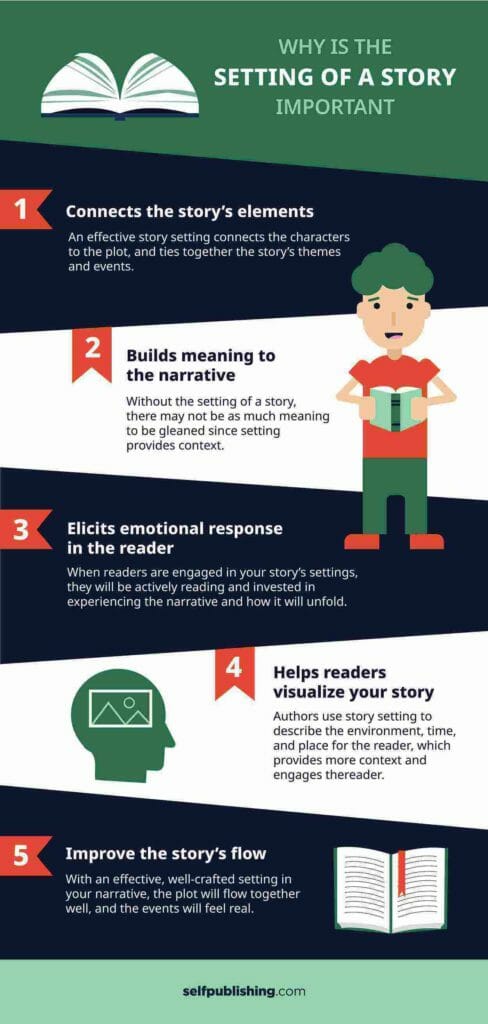
Setting is important because it provides context, creates mood, shapes character motivation, and makes the events of a story believable. Without a well-crafted setting, plot events feel arbitrary and characters feel untethered.
Here’s what a strong setting does for your story:
- Connects story elements. Effective setting ties characters to plot, and anchors your book’s themes to lived experience
- Builds emotional meaning. Context gives events weight. A betrayal in a cramped tenement hits differently than the same betrayal in a penthouse—setting shapes the reader’s emotional response
- Elicits reader investment. When readers can feel where they are, they stop reading about characters and start experiencing the story with them
- Drives character behavior. Environment affects mood for real people and for fictional ones. A character in a claustrophobic, hostile setting behaves differently than the same character in open, familiar terrain. The setting shapes character motivation in ways that must stay consistent throughout your manuscript
- Improves narrative flow. When setting, character, and plot are aligned, the story moves naturally. When they’re misaligned, readers feel it as friction even if they can’t name why
How to Decide the Setting of Your Story
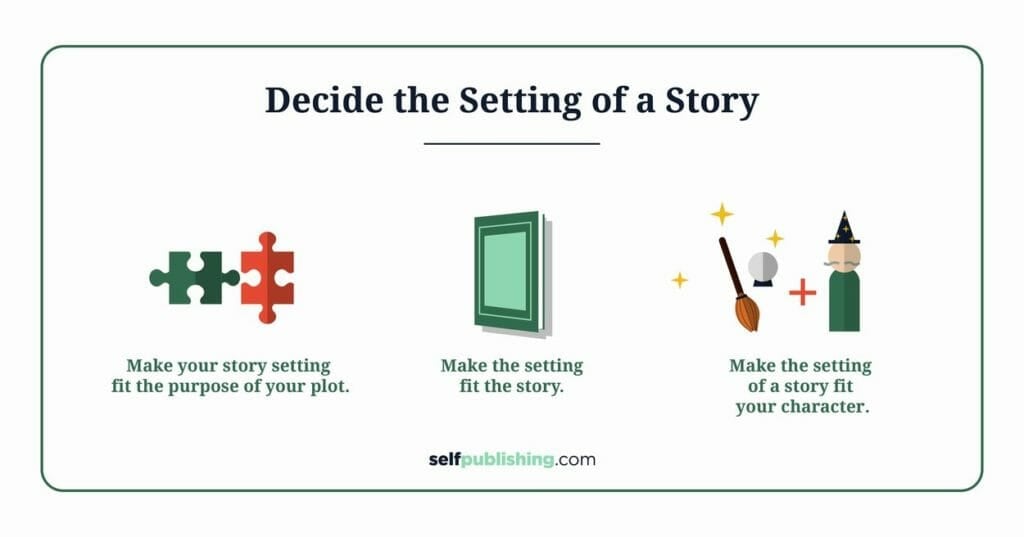
Choose your setting by aligning it with three things: your plot’s purpose, your story’s internal logic, and your main character’s psychology.
1. Match Setting to Plot Purpose
Your setting needs to make your plot plausible and give it the right energy.
A murder mystery set in an isolated rural town has different momentum than the same mystery set in Chicago. The rural setting creates claustrophobia and limited resources. The urban setting creates anonymity and noise. Neither is wrong, but you must choose deliberately based on the atmosphere your story requires.
Ask: What does my plot need from its environment to work?
2. Match Setting to Story Logic
Details within your setting must be internally consistent. If your story is set in 1970s America, a character can’t reference a smartphone. If your character drives an old Volkswagen Beetle through Manhattan, that car and that street must feel true to the era and the place.
Readers have strong instincts for anachronism. A single out-of-place detail can rupture immersion, and immersion is the goal.
3. Match Setting to Character
Your setting and your character bio should be developed in parallel, not sequentially. The two are interdependent.
A shy, withdrawn character who writes in a notebook during recess rather than playing with other kids…that detail only works if the setting (a school, an era, a social environment) makes it plausible. The character and setting reinforce each other, or they undermine each other. There’s no neutral.
How to Research the Setting of a Story
Research your setting by investigating the physical geography, cultural norms, historical events, social structure, and sensory texture of the time and place you’re writing about.
The key questions to answer before you write:
- What nationalities and demographics make up the population?
- What is the dominant religion or belief system? What minority ones exist?
- What superstitions, folklore, or cultural myths might shape character behavior?
- What is the terrain, climate, and typical weather for the season?
- What does the government look like? Is it trusted or feared?
- What is the history of the area, and how does it weigh on the present?
- What social norms govern how people interact — who is respected, who is marginalized?
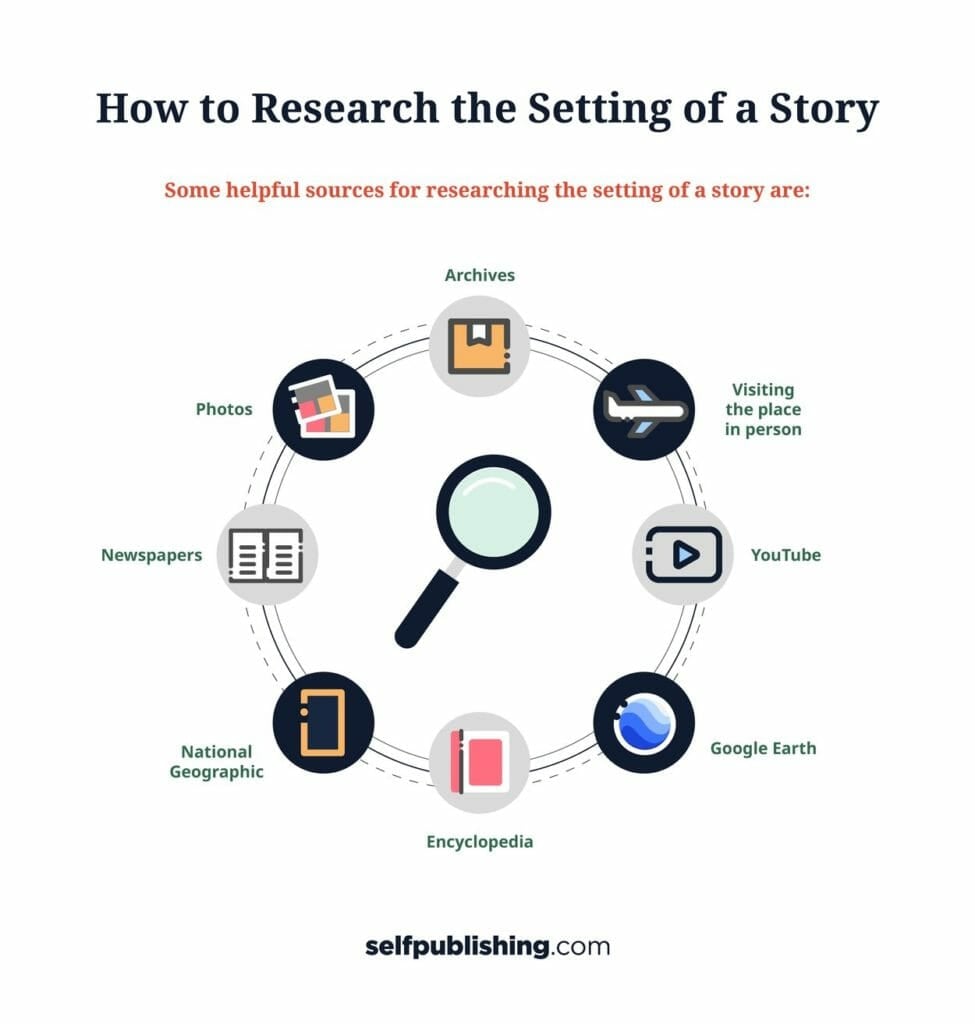
The Best Research Sources for Setting
- Visit in person. Nothing replaces firsthand sensory experience. If the budget allows, go
- YouTube. Footage of specific locations is surprisingly comprehensive—neighborhoods, weather conditions, historical footage
- Google Earth. Essential for terrain, scale, and spatial relationships between locations
- National Geographic. High-quality visual reference for geography, culture, and environment
- Newspapers and archives. Primary-source research for historical settings. The U.S. National Archives is an underused gold mine
- Encyclopedias. Underrated. Reliable overviews for historical and cultural context
- Photos. Google Image Search for specific locations, eras, and details gives you visual anchors for description
Writing a fantasy or science fiction world? You’ll also want to read our guide on how to make a fantasy map, a practical tool that forces you to commit to spatial logic before you start writing.
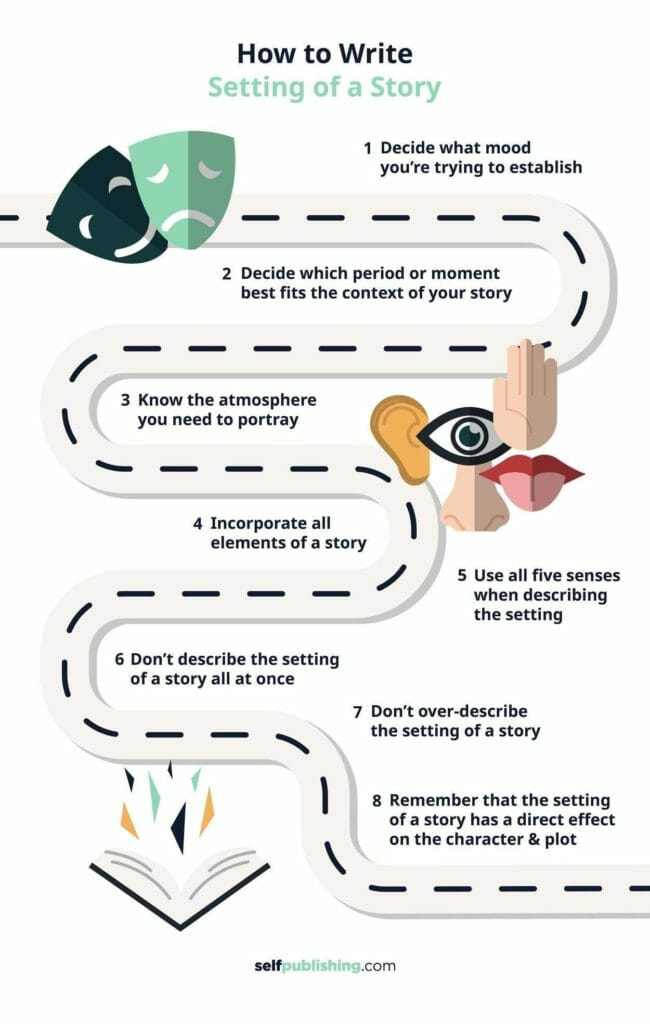
8 Tips for Writing the Setting of a Story
Tip 1: Decide the Mood First
Mood is the emotional atmosphere your writing creates in the reader and setting is the primary tool for establishing it.
Before you write a single descriptive word, define the emotional state you want readers to carry through the scene. Anxious? Melancholy? Hopeful? Sinister?
Every setting detail you choose should serve that mood. A bright summer morning in a park full of families signals safety, warmth, openness. A dark forest with gnarled trees and low-hanging fog signals dread, isolation, the unknown. These aren’t decorative choices, they’re narrative ones.
Mood inconsistency is one of the most common setting mistakes: writing a peaceful pastoral scene during a moment of high emotional tension. If two characters are building toward a confrontation, the setting should carry that tension rather than contradict it.
Tip 2: Choose Your Time Period Deliberately
The time period of your story determines what’s possible, what’s forbidden, how people speak, and what they believe so it must be chosen with the same care as any other story element.
Consider how social structures, technology, language, and cultural attitudes shift across eras. The way characters relate to authority, to each other, to the future, all of it changes with the time period.
The best time period is often one you know deeply and feel connected to. Emotional fluency with a time period translates directly into writing that feels lived-in rather than researched.
Look at the language you plan to use—the idioms, expressions, and references. Look at the objects your characters interact with. Look at who holds power and who doesn’t. All of these elements must be period-consistent.
Tip 3: Align Setting with Atmosphere
Atmosphere is the specific emotional charge of a scene, distinct from overall mood, it’s moment-to-moment. Your setting details must match the scene’s atmospheric demands.
If two characters are escalating toward an argument, the setting shouldn’t describe soft clouds, singing birds, and warm sunlight. That atmospheric mismatch tells the reader nothing is at stake. Instead, describe the heat, the closed windows, the way traffic noise makes it hard to hear. Details that create pressure.
The environment should feel like it’s reacting to the emotional situation, even when that reaction is implicit.
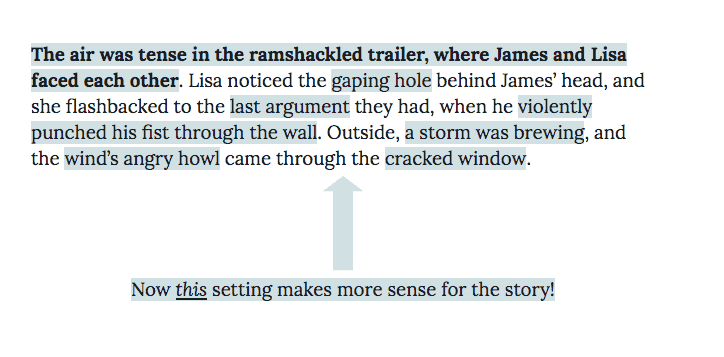
Tip 4: Use All Story Elements (Not Just Geography)
Setting encompasses more than terrain and weather. It includes the social order, religious beliefs, political climate, economic conditions, and cultural expectations of the world your characters inhabit.
You don’t need to explain all of this to readers directly. You need to know it…deeply enough that it influences every choice your characters make.
A character who lives in a deeply religious community behaves differently than one raised in a secular urban environment, even if the surface plot events are identical. The setting shapes the person. Work those social and cultural layers into your character development, and let them surface organically through action and literary elements rather than exposition dumps.
Tip 5: Engage All Five Senses
The most immersive settings don’t describe what characters see. They create the full sensory experience of being present in a place.
Here’s a practical sequencing approach:
- Sight: Start with the focal point, then let the eye travel naturally across the space
- Sound: Identify the most immediate and relevant sounds—not everything audible, just what this character would notice
- Smell: Often overlooked, smell is one of the most powerful memory triggers. Use it sparingly and specifically
- Touch: Have characters interact physically with their environment—the rough surface of a wall, the cold of a metal handle, the give of wet ground underfoot
- Taste: The rarest sensory detail in setting, but worth deploying when it’s natural. A character can “almost taste” a smell that’s strong enough
The key discipline: sprinkle these details throughout the scene. Don’t front-load them. Don’t deploy all five senses in the opening paragraph. Let sensory details emerge as the scene unfolds.
Tip 6: Distribute Setting Details Throughout the Narrative
Never open a chapter with a wall of setting description. Readers will skim it, or close the book.
This is one of the most reliable ways to lose a reader early. A paragraph-long description of a room before anything happens signals that the author is stage-managing rather than storytelling.
The most effective approach: introduce setting details in motion, woven into action and thought. A character notices the smell of mildew as she opens the door. She clocks the position of the exits before she sits. She feels the cold draft from the window while she’s having a conversation.
Setting details land when they’re embedded in what characters are doing, thinking, or feeling—not delivered as inventory.
You can experiment with different points of view (first person, second person, third person) to find which perspective makes it most natural to weave setting into the character’s moment-to-moment experience.
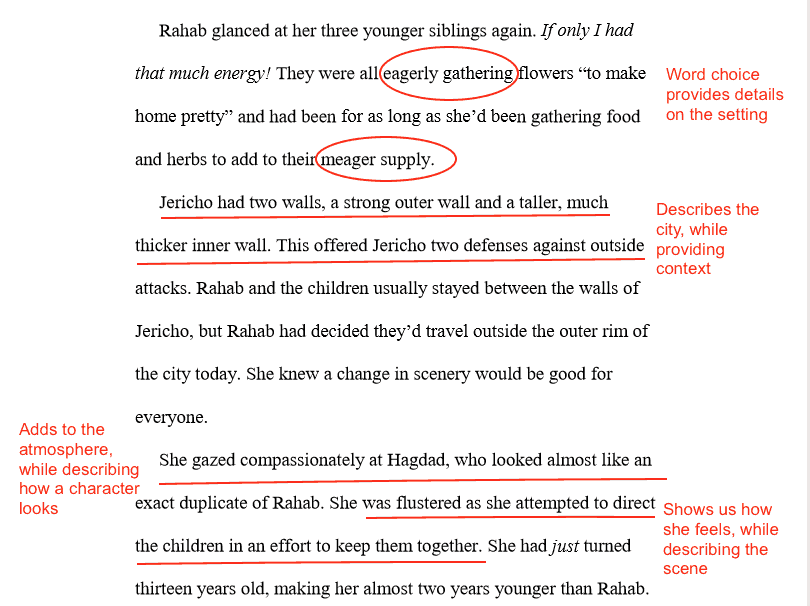
Tip 7: Don’t Over-Describe
Over-description is as damaging as under-description. It stifles imagination, bogs down pacing, and signals distrust of your reader.
Three things to remember:
- Leave room for the reader’s imagination. The reader’s mind filling in details is a feature, not a failure. You’re building a collaborative experience, not painting a photograph
- Readers know what common things look like. You don’t need to describe a buzzing fluorescent light in precise technical detail. Tell readers it buzzes like a dying fly—their mind supplies the rest
- Over-description breaks immersion. The moment readers become aware that they’re being described to, they step out of the story. The goal is invisible craft
The test: if a detail doesn’t serve the mood, advance the plot, or reveal something about the character…cut it.
Tip 8: Let Setting Shape Character and Plot Actively
Setting isn’t a container for your story, it’s a force that acts on your characters and generates plot. Environment affects real people’s mood, behavior, and choices. It must do the same for your characters.
A character who lives in a decaying, cold apartment with a furnace that won’t stay lit is not the same as a character in a warm, stable home. The physical conditions of her world bleed into her psychology, her patience, her hope, her tolerance for risk. Those conditions then generate plot: she makes decisions driven by her environment that she wouldn’t otherwise make.
When setting, character, and plot are genuinely interdependent, when the environment couldn’t be swapped out without changing the story, you know your setting is doing real work.
Get Our 6″ x 9″ Pre-Formatted Book Template for Word or Mac
We will send you a Book Template for US Trade (standard paperback size).
How to Write a Fictional Setting (Fantasy & Science Fiction)
For fictional worlds, complete your world-building before you begin writing, then build your specific setting within that world, and only then start your manuscript.
This sequence matters. Writers who start drafting before the world is built consistently discover mid-draft that they’ve contradicted themselves and face major rewrites.
Step 1: Build the World First
Before your characters exist in their world, that world needs internal consistency: its rules, its history, its power structures, its geography, its relationship with magic or technology.
J.R.R. Tolkien is the canonical example. He had books full of world-building material—languages, histories, maps, genealogies—before The Lord of the Rings existed as a narrative. That depth of world-building is what gives Middle-earth its feeling of reality.
Your fictional world needs to answer every question a reader might ask, even if 90% of those answers never appear on the page.
Step 2: Build the Specific Setting Within the World
Once the world exists, define the specific environments your characters inhabit. Consider:
- How many suns or moons does this world have? What do they mean culturally?
- What is the plant life like? Carnivorous? Bioluminescent? Edible?
- What animals exist? Are they companions, threats, sources of power?
- What does the sky look like at different times of day or season?
- What governs this environment—weather patterns, tides, magical cycles?
Think outside conventional Earth-based reference points. Your readers have no default frame of reference for your world. You must build it for them, detail by detail, across the full length of the narrative.
Step 3: Draw a Map
A map is not just a visual aid—it’s a consistency tool.
Drawing a fantasy map forces you to commit to distances, terrain types, and the relationships between locations. It prevents the common error of a journey that takes two days in Chapter 3 but half a day in Chapter 11. It gives you a reference for every travel scene, every character location, every spatial relationship in the story.
Map the important places: cities, routes, landmarks, hideaways. Include distance markers. It will save you hours of continuity editing later, and it may generate story ideas you wouldn’t have found otherwise.
Setting vs. Other Story Elements: Key Distinctions
| Element | Definition | How It Relates to Setting |
| Setting | Time, place, and environment | The world the story inhabits |
| Mood | The emotional feeling a scene creates | Setting is the primary tool for creating mood |
| Atmosphere | The immediate emotional charge of a moment | Setting details must match atmospheric demands scene by scene |
| Theme | The central idea the story explores | Setting can embody theme (e.g., decay, freedom, isolation) |
| Character | The people living through the story | Setting shapes character psychology and motivation |
| Plot | The events that unfold | Setting creates the conditions that make plot events possible |
Common Setting Mistakes to Avoid
Front-loading all setting description. Readers skim opening description blocks. Weave setting into action from the first page.
Ignoring social and cultural environment. Terrain and weather are only two layers of setting. The social world—religion, class, gender dynamics, political power—shapes characters just as powerfully.
Setting that contradicts character mood. If your character is in crisis, your setting should carry that pressure, not undercut it with peaceful imagery.
Inconsistent time period details. One anachronistic detail—a phrase, a technology, a cultural reference—can break reader trust for the rest of the book.
Never updating the setting. Setting should evolve as the story does. The world your character inhabits at the end of a novel should feel different from the world at the start, even if the geography hasn’t changed.
Forgetting that character bios and setting are interdependent. Build them simultaneously. A character’s history, psychology, and behavior are inseparable from the environment that shaped them.
Frequently Asked Questions
What is the setting of a story? The setting of a story is the time, place, and environment in which the narrative takes place. It includes physical location, time period, social climate, cultural context, and atmospheric conditions, all of which shape the characters and events of the story.
What are the three types of setting? The three types of setting are time (historical period, season, time of day), place (physical location—city, building, landscape), and environment (the social, cultural, political, and atmospheric conditions surrounding characters).
Why is the setting of a story important? Setting is important because it establishes mood, grounds characters in a believable world, shapes character motivation and behavior, and creates the conditions that make plot events plausible and emotionally resonant.
What makes a good story setting? A good setting aligns the time, place, and social environment with the needs of the plot and the psychology of the characters. It is introduced gradually through action and sensory detail rather than front-loaded as description, and it actively influences what characters do and feel throughout the narrative.
How do you find the setting of a story? To identify the setting of a story, look for descriptions of time, place, and environment throughout the text—in opening paragraphs, character observations, and dialogue. Skilled authors embed setting subtly through sensory detail and character reaction, rather than stating it directly.
How does setting affect character development? Setting shapes character by determining what a character has experienced, what they fear, what they want, and what constraints they operate within. A character’s psychology is inseparable from the environment they grew up in and currently inhabit, which is why building your setting and character bio template in parallel produces stronger results than treating them separately.
How do I write a fictional setting for fantasy or sci-fi? Build the world first (its rules, history, and geography), then define the specific setting your characters inhabit within that world, then begin writing your manuscript. Drawing a detailed map before you start drafting prevents spatial inconsistencies and generates story ideas.
Start Writing Your Setting Today
A powerful setting isn’t built in a single session. It emerges from research, deliberate choices, and the discipline to weave it across every page rather than deposit it in a single block.
The process: define your mood first. Research the time, place, and culture thoroughly. Build your world before your scenes. Develop your setting and characters in parallel. Then write using all five senses, distributed across the narrative, serving the story at every moment.
If you want to go deeper on the craft of fiction—character, plot, dialogue, structure—and get expert support taking your manuscript from draft to published book, schedule a free strategy call with the selfpublishing.com team.
Or use our free writing prompts generator to practice building settings right now. Choose a prompt, set a 10-minute timer, and write the setting before anything else happens. You’ll be surprised how much you already know.
Writing Prompt Generator
for Book Ideas
I want to write...
Genres
Writing Prompt Generator
for Book Ideas
Your Book Prompt:
Want to receive personalized tips on how to sell more books right in your inbox?
Last updated: April 2026
The post Setting of a Story: 8 Tips for Creating an Immersive Setting appeared first on selfpublishing.com : The #1 Resource For Self-Publishing a Book.