4 months ago
16
4 months ago
16
As horror authors, we can only dream of conjuring up a title so sinister it sends a chill down our soon-to-be-readers’ spines. And a horror book title generator just might make that ̶d̶r̶e̶a̶m̶ nightmare come true.
Horror is the goth little sister of the literary family—kinda fun, kinda weird, and brings the necessary spice to keep things interesting. Nothing hits like a good horror story, but there’s something standing between a reader and their next favorite scary book: The title.
Without a killer title, your horrifying tale may never be told! The power of a well-crafted title is everything. Let’s look at some tips for writing strong horror titles, examples of famously done titles, and then talk about the (free!) tool that will create your next title for you.
Book Title Generator
Access the tool: AI Book Title Generator
TL;DR
A horror book title generator is a free tool that creates scary, genre-specific book titles from your description, tropes, or target audience. The best horror titles evoke emotion, embrace ambiguity, stay short, match tone, and use symbolism. Use selfpublishing.com’s free horror book title generator to produce unlimited ideas in seconds, then shuffle and edit them into a title that actually sells.
What is a horror book title generator?
A horror book title generator is a tool that produces scary, genre-aligned book titles based on your plot, tropes, setting, and target reader. It replaces hours of brainstorming with seconds of iteration.
Horror is the goth little sister of the literary family – kinda fun, kinda weird, and the spice that keeps fiction interesting. But nothing stands between a reader and their next favorite scary book like a weak title. The title is the first piece of marketing your book does, and a bad one can bury even a brilliant manuscript.
That’s where a generator earns its keep. It gives you volume, variety, and angles you wouldn’t reach on your own so you can craft your way to something genuinely chilling.
Below you’ll find the five rules for writing terrifying titles, a breakdown of iconic horror titles and what makes them work, and a step-by-step walkthrough of our free book title generator.
5 Tips for writing terrifying titles
A good horror book title generator (whether that generator is YOU or a tool) should come up with something that accomplishes several objectives. It needs to grab attention, accurately represent the content in your book, and appeal to the right target demographic.
But an excellent horror book title is a piece of art in itself! Here are five tips for crafting the perfect book title – whether you decide to use a horror book title generator or nothing but your own creativity.
Evoke emotion
A scary title should make the reader feel something before they even open the book. Horror trades in isolation, grief, terror, dread, and the exploration of our deepest fears. Your title should deliver a small dose of that feeling on the cover.
Stephen King’s Misery conjures helplessness in a single word. Edgar Allan Poe’s The Tell-Tale Heart implies a secret that refuses to stay buried. Both titles work because the emotion is front-loaded.
Ask yourself: What single feeling do I want a browsing reader to have when they see this title? Build around that.
Embrace ambiguity
The best horror titles tease without spoiling. They raise questions your book spends 300 pages answering.
- The Haunting of Hill House – What kind of haunting? Why this house?
- The Call of Cthulhu – Who is Cthulhu? What does he want?
- Bird Box – Why is the bird in the box?
Leave room for interpretation. If the title explains the plot, you’ve given the reader their reward before they buy the ticket. A title generator is especially useful here. It will suggest strange, evocative pairings you’d never invent on your own
Edit out the fluff
Short beats long in horror. Psycho. It. Misery. Carrie. Four classic titles, seventeen letters between them.
Brevity carries tension. A single word or a tight phrase hits faster than a subtitle-stacked explanation. Anne Rice’s Interview with the Vampire works because every word pulls its weight (the allure, the intimacy, the threat) all packed in four words.
Match the tone of the book
There are many different types of tones in writing, and the one you choose depends on your cast of characters, the type of horror you are writing, and your own personal style. For example, the differences between horror and thriller books call for different tones. One is downright scary, while the other is characterized by a tense feeling – or even confusion.
What is certain is that your chosen title should reflect and represent the overall tone and/or atmosphere of your story (whatever you choose it to be). If your story is a slow-burn psychological thriller, words like “whisper,” “shadow,” and “trace” might be more fitting than an aggressive, gory title.
| Slasher / splatter | Blunt, visceral nouns: Chainsaw, Slaughterhouse |
| Psychological | Quiet, internal words: Whisper, Shadow, Trace, Silence |
| Supernatural / gothic | Place names, archaic words: Haunting, Hill House, Rebecca |
| Cosmic / weird | Unfamiliar proper nouns: Cthulhu, Annihilation |
| Survival / creature | Scale and threat: The Ruins, The Terror, World War Z |
Play into symbolism
Incorporating symbolism – even if unknown – can add depth and layers to your book before someone even read the first page. It intrigues readers while providing a glimpse into the thematic content of your book.
William Peter Blatty’s “The Exorcist” does a great job indicating the literal content (possession, demons, Catholicism, etc) but it also symbolizes the inner demons haunting the characters.
As you can see, an effective horror book title is at once simple and incredibly difficult. You should start thinking on the title during or even before writing your first rough draft. Not only does the title work with the story to create its own little art piece, but the title is a huge marketing and book positioning tool – if it sounds boring or trite, it just won’t sell as well.
Similarly, if the title is misleading, you might stack up more 1-star reviews than is ideal.
So, are you ready to give it a try? Check out the horror book title generator here. Otherwise, keep reading for some more inspiration and tips for getting the most out of this free tool.
Book Title Generator
Access the tool: AI Book Title Generator
6 iconic horror book titles and why they work
The easiest way to train your instinct is to reverse-engineer titles that worked. Here are seven horror classics and the specific lesson each one teaches.
“Dracula” by Bram Stoker
A timeless classic, Stoker’s “Dracula” remains a paragon of horror literature. Its title immediately conjures images of the iconic vampire, evoking a sense of dread and fascination.
And even before Dracula became a famous literary figure, this word had significance. “Dracula” is derived from the Latin word for “dragon,” a creature historically associated with demons.
“Psycho” by Robert Bloch
A title that taps into the psychological horror subgenre, “Psycho” captures the enigmatic and unsettling nature of the human mind. It lets us know the type of person we’re dealing with, as well as being indicative of the genre itself. It’s a snappy, concise, iconic title.
“Something Wicked This Way Comes” by Ray Bradbury
Borrowed from a line in Shakespeare’s “Macbeth,” (“By the pricking of my thumbs, something wicked this way comes) this title sets a foreboding tone and hints at the arrival of malevolent forces. We know immediately the story involves supernatural elements, and specifically, that those elements have ill intent.
It’s also just super metal.
“Bird Box” by Josh Malerman
Short and evocative, this title draws attention to the unknown and the unseen, mirroring the story’s theme. There is a literal bird in a box, but it is a metaphor for how the characters are also like boxed birds—technically safe, but denied real freedom.
“Bird Box” is also an unusual pairing of words, making it immediately iconic. If you can craft a horror book title so unique, your book and author website might easily appear quite high in Google results. Think about it!
“The Silence of the Lambs” by Thomas Harris
This title is an exemplar of psychological terror, invoking both the quiet manipulation of Hannibal Lecter and the unsettling nature of the crimes. It also works as a metaphor for murder victims—lambs are slaughtered, and then they are silent.
“World War Z” by Max Brooks
A title that sends shivers down the spine, “World War Z” immediately conveys the global scale of the undead apocalypse. I don’t know if rhyming with World War III was intentional, but it does evoke that same unsettling feeling upon mention.
Looking for listening material? See our roundup of the best horror audiobooks for more title inspiration.
A step-by-step how-to: using the horror book title generator
Use the horror book title generator in four steps: open the tool, input your book details, generate multiple titles, then shuffle and edit. Most authors get a usable working title in under 10 minutes.
Step 1: Mosey on over to the horror title generator
We love the book title generator so much that we gave it its own page, but you can use the embedded one here as well. As a reminder, the book title generator works for any genre, fiction or nonfiction, but let’s look at how to create a horror book title.
Book Title Generator
Step 2: Insert information
The more you know about your book, the generator has enough to work with.
There are basically two ways to use it. One is to select “fiction,” from the first dropdown menu, then type in your book description. For example, I selected fiction, and the description I provided was: A young girl ventures into a swamp to ask the witch who lives there for a favor. When the girl arrives, she realizes the witch is nothing like how the townspeople had described.
The above description gave me this result:
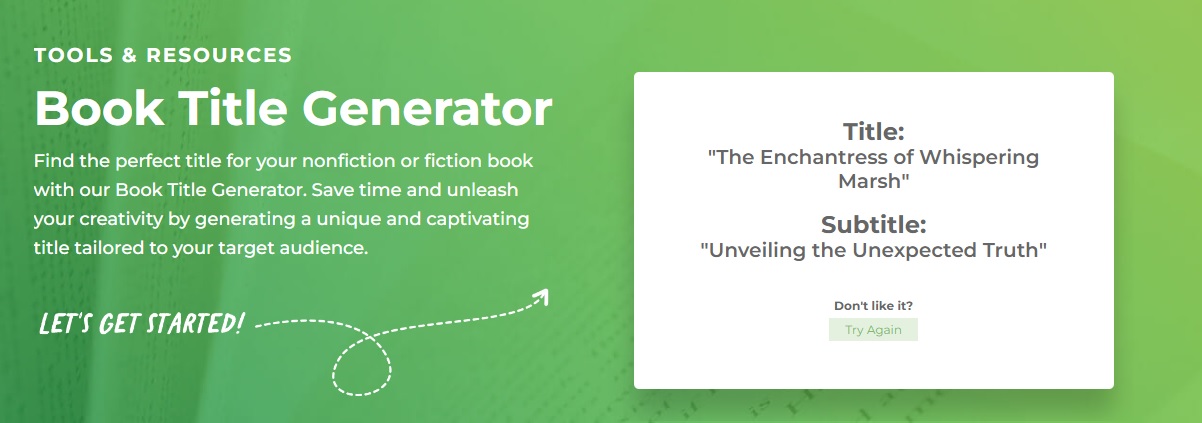
If you don’t like the title, simply click “try again” to produce another!
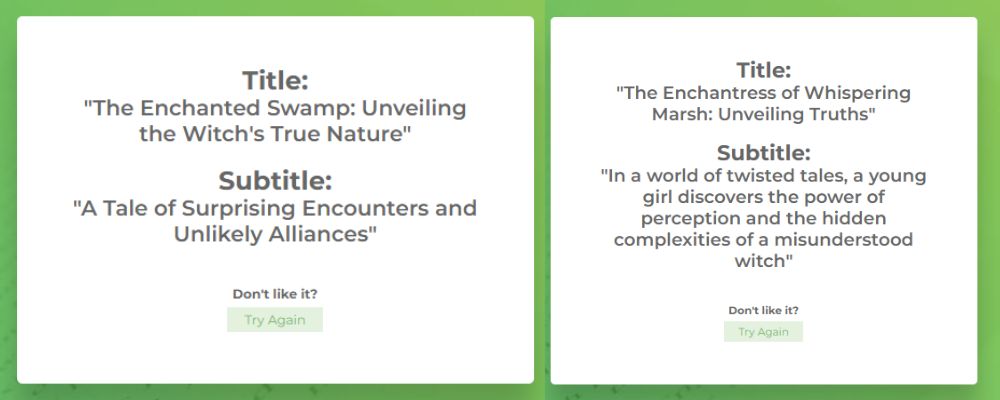
If you don’t have a description yet, no worries! The second way to use the generator is with the following information:
- Your book genre
- Your book’s setting
- Your target audience
- A one-sentence description of your hero
- Tropes
- Subgenre
Let’s try it!
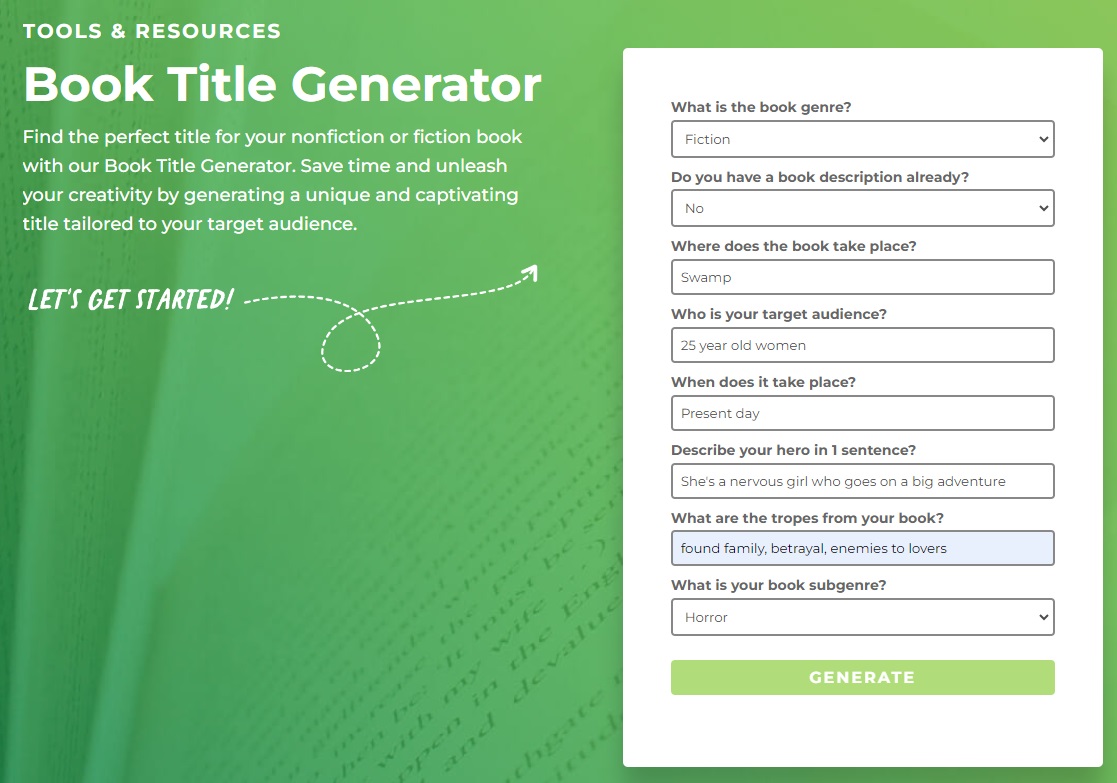
Here are my first few results:
- Shadows of Deceit: Unveiling the Darkness (A Nervous Girl’s Journey into the Enigmatic Abyss of Found Family, Betrayal, and Unlikely Love)
- Whispers in the Shadows: Unveiling the Darkness (An Unlikely Hero’s Journey into a Twisted World of Found Family, Betrayal, and Love Born from Desperation)
- Whispers in the Dark: A Haunting Journey of Found Family and Treacherous Love (The Unsettling Tale of a Timid Heroine’s Terrifying Quest to Uncover the Truth)
Step 3: Click generate
It’s a good idea to generate several titles, writing down the ones that you think have potential. You could do this 10 times or 100 times, up to you! Having too many options can make decisions impossible, but do you want enough to work with.
Step 4: Shuffle and edit
With your list of titles, start experimenting! You might take the title from one and the subtitle from another or merge several titles. You’ve probably noticed that the generator gives you a LOT of words—that means you can trim out the ones you don’t think work and still have plenty left. If you scroll Amazon titles, you’ll see authors utilizing those huge subtitles to work the algorithm. Don’t be afraid of a subtitle!
Titles are the middleman connecting your perfect reader to your scary story ideas and/or horror book. Use the tips and tools above to create a title worthy of introducing your story to the world.
Horror title generator vs. writing titles by hand
Both methods work. The right choice depends on where you are in your process.
| Speed | 20+ titles in 5 minutes | Hours or days |
| Variety | High — AI pairs words you wouldn’t | Limited to your instincts |
| On-brand voice | Medium — needs editing | High — it’s your voice |
| Keyword optimization | Good — AI knows genre conventions | Depends on your SEO knowledge |
| Best for | Brainstorming, overcoming blank page | Final polish, unique voice |
| Cost | Free | Free (but expensive in time) |
The answer for most authors: use both. Generate 20+ with the AI tool, then apply the 5 tips above to shape your favorite into something only you could have written.
Common mistakes authors make when titling horror books
1. Titles that reveal the ending
If your title is The Killer Was Her Brother, there’s no book left to read. Tease, don’t tell.
2. Titles that don’t match the subgenre
A psychological thriller titled Bloodsoaked will attract splatter-horror fans who leave 1-star reviews when they get Hitchcock instead. Match tone to content, see the difference between horror and thriller.
3. Generic titles that blend into the category
Dark Shadows, The Haunting, The House. These titles exist on every single horror shelf. A quick Amazon search for your working title tells you whether you’re standing out or disappearing.
4. Ignoring subtitle SEO
Amazon is a search engine. Your subtitle is keyword real estate. Authors who skip it lose visibility to authors who pack relevant terms into theirs.
5. Falling in love with your first title
The title you invented in week one of drafting is almost never the title that sells the book. Stay flexible. Keep generating.
6. Titling before you understand your book
Your title should reflect your finished story’s tone, climax, and core metaphor. If you don’t know those yet, you’re guessing. See how to write a novel for the foundational work that makes titling easier.
FAQ
Is the horror book title generator really free?
Yes. The selfpublishing.com book title generator is free, unlimited, and works for every genre including horror, romance, fantasy, and children’s books.
How many titles should I generate before picking one?
Generate at least 20. Most authors find their winning angle somewhere in the second or third batch, after the obvious suggestions burn off.
Can I use AI-generated titles commercially?
Yes. Titles cannot be copyrighted in most cases, and AI-generated suggestions are free for you to use, modify, or combine as you see fit.
What makes a horror title different from a thriller title?
Horror titles lean into dread, the supernatural, and emotional vulnerability (Misery, The Exorcist). Thriller titles lean into speed, stakes, and action (Gone Girl, The Silent Patient). If you’re not sure which you’re writing, our guide on how to write a horror story breaks down the distinction.
Should I add a subtitle to my horror book?
Usually yes, especially if you’re publishing on Amazon. A short main title plus a keyword-rich subtitle (e.g., “A Gothic Haunted House Horror Novel”) maximizes both aesthetic punch and search visibility. See our full breakdown of how to write book titles.
What if I can’t find a title I love?
Two options. First, finish a draft. Titles get easier after the book is written because you know what the book actually is. Second, workshop it. Run your top 5 past beta readers and horror fans. The winner is almost never the title you loved most; it’s the one they remembered a week later.
Write the book that deserves a killer title
Your title is the middleman between your perfect reader and the horror story only you can tell. Use the tips and the free generator to create a title worthy of the story behind it.
If you want the full system (coaching, editing, publishing, and marketing) for getting your horror novel into readers’ hands, book a free consultation with our team. We’ve helped 7,000+ authors publish, and we’d love to help you write the one that keeps people up at night.
The post Create Terrifying Titles: Free Horror Book Title Generator appeared first on selfpublishing.com : The #1 Resource For Self-Publishing a Book.