4 months ago
16
4 months ago
16
Over these past posts on microtension, we’ve looked at many ways to create contradictions and incongruencies in our prose to carve pathways for microtension (If you haven’t read the series yet, start with this one). The objective is to drop in creative “sticky bits” so that readers not only don’t get bored by the ordinariness or predictability of the prose but are delighted by surprise and originality.
I’ve mentioned how important (many times!) it is to consider your genre and audience. Every element of your story needs to work together to fit your genre (and this applies to genre mash-ups as well). That includes character voice, scene mechanics (length of scenes, sentences, and paragraphs, amount of white space, how punctuation is used), and word choice.
High fantasy is going to read a whole lot different that a rom-com. As with any element, such as emotion, sensory details, or creative imagery, your genre will dictate the amount and type. And, of course, within genres you’ll find a spectrum, not hard-and-fast rules. One thriller can be primarily a deep character study and journey, whereas another might be 95 percent high-octane action with little concern for the hero’s emotional journey.
That gives us writers a lot of leeway when it comes to the type and amount of microtension. It is only logical that, at this point, you may be thinking: I write action-adventure. These types of novels aren’t going to have gobs of incongruent emotions and contradictions in word choice.
That’s such an important point. A military thriller or a cozy romance may only have a few “sticky bits” per page—maybe a creative use of a verb or adjective, a simile, or an unexpected thought. That’s perfectly fine and apropos.
I always urge writers to do their homework: study current best sellers in their genre for every element, not just microtension. If you know, on average, how much emotion or description is shown per page in novels in your genre and close to your writing style, then you have a template of sorts.
Here’s an excerpt from The Ascent by Adam Plantinga, a thriller set in the milieu of a prison riot. Argento is a prisoner, but he used to be a cop. He’s concerned about a girl who is there on a tour and seems to be in a vulnerable position. Note the tight, engaging writing; strong deep POV; and simmering conflict. Only a bit of microtension is dropped in.
“You can relax, Samaritan,” the white trooper told Argento. “You don’t need to know who she is. She’s got all the help she needs. Now for the last time, walk. Or your head is where I’m gonna keep my bullets.”
Your head is where I’m gonna keep my bullets. It sounded like a line he’d stolen from some shitty gangster movie. The white trooper was close to Argento. Too close. And his arm was still fully extended instead of held snug to his body for proper tight quarters firearm retention. He was used to pointing guns at people and gaining compliance. Argento’s experience had been different as an officer in inner-city Detroit. He had pointed guns at hardened parolees who had laughed at him …
Argento put his hands up in resignation, but it was all for show. What he was going to do next required a supreme belief in his own abilities and no small amount of doubt in the abilities of the white trooper. The former he had. The latter was an educated guess. The trooper was full of bravado, and Argento was betting big on it not being earned. He had momentarily taken his eyes off Argento when Brown Suit had asked him a question, which was a tactical blunder. Plus he had a stupid mustache.
Argento had three more things going for him. The first was fast hands. The second was that the trooper’s finger was off the trigger of his firearm, as all police training dictated, because he hadn’t yet committed to shoot. And the third was that action beats reaction, every time.
Argento started backpedaling. Make ’em think you’re doing one thing. Then he moved forward. Then do the other. He stepped in close to the trooper, at a forty-five-degree angle. He took the Guardian out of his hand with a sharp twist of the trooper’s wrist and moved away, flush against the wall, the gun down at his side. It had been a risky move. The white trooper could have exceeded Argento’s expectations and lit him up when he tried for the gun. But Argento had never been risk averse. Especially not these days. In fact, at that moment, he didn’t care if he took a bullet. Getting shot might be a step up for him.
“If she has all the help she needs,” Argento said, “then why was that so easy?”
The tension here is in the action (hence, why thrillers are in the action/adventure genre). But we get nice bits of microtension with the stupid mustache and getting shot might be a step up for him (irony).
And, just to add to your list of literary devices, a charactonym is when you give someone a name based on a trait or action of that person—usually done in fiction when the POV character doesn’t know another’s name (Brown Suit in this passage).
Ken Follett’s novel Never is the kind of novel that isn’t going to be packed with literary devices and lyrical language. But, being a master thriller writer, Follett creates pathways for microtension in the way he opens the story cinematically with a car traversing the Sahara Desert, and the POV character likening the journey to being on the moon, clustering words and imagery to that end to set the appropriate mood.
Seen from a plane, the car would have looked like a slow beetle creeping across an endless beach, the sun glinting off its polished black armor. In fact it was doing thirty miles per hour, the maximum safe speed on a road that had unexpected potholes and cracks. No one wanted to get a flat tire in the Sahara Desert.
The road led north from N’Djamena, capital city of Chad, through the desert toward Lake Chad, the biggest oasis in the Sahara. The landscape was a long, flat vista of sand and rock with a few pale yellow dried-up bushes and a random scatter of large and small stones, everything the same shade of mid-tan, as bleak as a moonscape.
The desert was unnervingly like outer space, Tamara Levit thought, with the car as a rocket ship. If anything went wrong with her space suit she could die. The comparison was fanciful and made her smile. All the same she glanced into the back of the car, where there were two reassuringly large plastic demijohns of water, enough to keep them all alive in an emergency until help arrived, probably.
Here’s a cozy romance, about an older retired woman who moves from New York to Florida, where she runs into an old flame. The opening to The Love Elixir of Augusta Stern by Lynda Cohen Loigman is sprinkled with a few choice bits of microtension, like in these three separate passages:
“You have been a very valuable member of this institution, Ms. Stern. It’s not my intention to coerce you in any way, but given your approaching milestone birthday, I was wondering whether you might be reconsidering retirement?”
For the briefest of moments, Augusta closed her eyes. The answer to the question came to her slowly, like a malted milkshake through a too-narrow straw.
She had just spotted her sandals and bag on a chair when she heard a man calling to her from behind. “Goldie!” said the voice. “Is that you?”
Augusta froze solidly in place. Despite the heat and the sunshine, she shivered visibly in her swimsuit. Goldie? She hadn’t allowed anyone to call her that for more than sixty years.
Impossible, she told herself.
When she didn’t answer, the man spoke again. “Goldie? Goldie Stern?”
The voice was rough and much too loud, causing the other pool-goers to stare. Augusta felt all their eyes upon her as they looked up from their books and magazines. Even the women in the shade paused their card game to squint at the newcomer. There was nowhere now for Augusta to hide, nothing to do but turn around. Half-naked and on display, she felt like a cheap music box ballerina, forced into a clumsy spin.
The last time she’d seen him, she was eighteen years old—young and trusting and deeply in love. She was none of those things now. She removed his hand, took two steps back, and crossed her arms over her damp chest.
“Of course I remember,” she snapped.
“I thought you said you’d never leave New York.”
“And I thought you’d be dead by now.”
He threw his head back and barked out a laugh. “Still as sharp as ever,” he said. “What brings you to Rallentando Springs?”
“I moved here yesterday,” said Augusta. The whisper of panic in her head grew louder. “Don’t tell me you live here, too?”
The smile he gave transported her back to the first day they met in her father’s drugstore—back to a time when her heart was still soft, like overripe fruit left out in the sun. Back to when lines were still blurry, hope was abundant, and love did not seem so far out of reach.
Irving Rivkin winked at her slyly. “You’d better believe it,” he said.
We have the similes (the malted milk, the music box ballerina, the heart like overripe fruit), the snappy dialogue line (“I thought you’d be dead by now”), and the brief repetition for emphasis (back to a time; back to when lines). They add those nice bits of microtension that help give depth to this character.
Even with genres like these, if you look for key moments (anchor points) in the scene, you can slip in enough microtension to make your prose memorable and your story engaging.
Learning the fine art of microtension is going to help your prose rise from the mire of the mundane and catch readers’ attention. Imagine the thousands of sample chapters agents and acquisitions editors slog through to find that one “gem” among the pile of dull “rocks.” The more gems you can organically and masterfully insert into your pages, the more your book will stand out—regardless of the genre!
New Release! Masterful Microtension
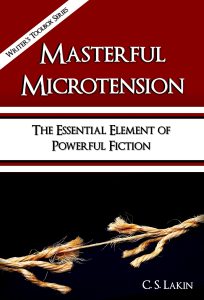 Learn how to masterfully craft microtension in your fiction. Microtension is the subtle but powerful element operating beneath the surface of a scene. It is created through contradiction, emotional friction, subtext, charged description, symbolism, and imaginative wordsmithing. When microtension is present, readers feel compelled to keep reading. When it’s missing, even well-plotted stories can feel flat.
Few writers have ever been taught about microtension in fiction and why it’s so important. And you’ll be hard-pressed to find any books, courses, videos, or articles on it. Yet … without it, your fiction can fall flat.
In Masterful Microtension: The Essential Element of Powerful Fiction, you’ll study how skilled fiction writers create tension at the micro level using masterful techniques such as word pairings, literary devices, motifs, and polarities.
Most books on fiction writing focus on structure, character arcs, and dramatic conflict. While those elements are crucial to a great story, they only address the big-picture elements. Microtension works at the word level, shaping the emotional energy between narrative, actions, and thoughts.
Regardless of what genre you write, Mastering Microtension will magnificently transform your prose. If you want to elevate your fiction from competent to compelling, from readable to unforgettable, microtension is the key.
Get your copy (ebook or paperback) on Amazon or any other outlet online! (release date 4-28-2026)
Featured Photo by Robert Anderson on Unsplash
The post Microtension in Fiction by Degrees appeared first on C. S. Lakin.