4 months ago
18
4 months ago
18
Writing a research paper is an exercise in high-level communication. It requires the author to distill complex data, intricate theories, and rigorous methodology into a format that another person can understand and replicate.
However, many researchers fall into the trap of believing that academic weight is measured by the length of a sentence or the complexity of the vocabulary. In reality, the most impactful research is characterized by its clarity. Achieving this level of precision depends heavily on your mastery of academic writing grammar.
How does grammar impact the overall clarity of a research paper?
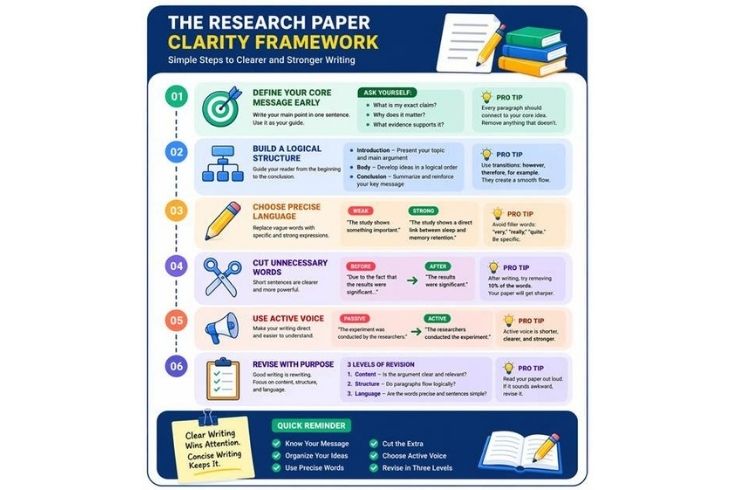
Grammar is often viewed as a restrictive set of rules, but in the context of research, it functions as a roadmap for the reader. When grammatical structures are weak, the reader must spend unnecessary mental energy deciphering the relationship between ideas rather than focusing on the findings. Clear research writing relies on the logical arrangement of words to convey specific meanings without ambiguity.
A paper riddled with inconsistent tenses, misplaced modifiers, or dangling participles creates “noise.” This noise distracts from the core message and can even lead to the misinterpretation of data. For example, if a researcher is inconsistent with verb tenses when describing a methodology, the reader may become confused about which actions have been completed and which are ongoing. Using an AI homework helper can assist in identifying these subtle errors before submission.
By prioritizing correct academic writing grammar, you ensure that your prose remains transparent. This transparency allows your intellectual contributions to stand at the forefront.
How can the active voice transform complex academic sentences?
One of the most effective ways to improve concise academic prose is to favor the active voice over the passive voice. In an active sentence, the subject performs the action. In a passive sentence, the subject receives the action. While the passive voice has a historical place in science for emphasizing the “objectivity” of a process, overusing it leads to bloated, indirect, and often confusing sentences.
Consider the following examples:
- Passive: The experiment was performed by the technicians over a period of three weeks.
- Active: The technicians performed the experiment over three weeks.
The active version is shorter and more direct. It identifies the “doer” of the action immediately, which provides better flow. Passive voice often requires additional helper verbs (like “was” or “were”) and prepositions (like “by”), which increase the word count without adding value. While you may still use the passive voice to describe specific procedures where the actor is irrelevant, using the active voice for your arguments and conclusions will make your paper significantly more engaging and easier to read.
Why should you eliminate nominalizations to improve sentence flow?
Nominalization is the grammatical process of turning a verb or an adjective into a noun. In academic circles, these are often referred to as “zombie nouns.” They suck the life out of a sentence by hiding the primary action behind a heavy, static noun. When you use nominalizations, you often need to add “weak” verbs like “conducted,” “performed,” or “facilitated” to make the sentence work.

Common examples of nominalization include:
- Nominalized: We conducted an investigation into the results. (Verb: Investigate)
- Concise: We investigated the results.
- Nominalized: There was an agreement between the two parties. (Verb: Agree)
- Concise: The two parties agreed.
Eliminating these nouns is a core component of scholarly syntax. It forces the writer to use strong, evocative verbs. When you scan your draft, look for words ending in “-tion,” “-ment,” or “-ance.” Often, these words can be converted back into verbs, which immediately tightens the prose and improves the logical momentum of your paragraphs.
How do precise verbs and the removal of “wind-ups” reduce wordiness?
Many researchers use “wind-ups” or “filler phrases” to introduce a point. These are groups of words that provide no new information but act as a sort of linguistic runway. While they might feel polite or formal, they actually obscure the grammatical subject of the sentence and delay the arrival of the actual point.
Common wind-ups to avoid include:
- “It is interesting to note that…”
- “It should be pointed out that…”
- “The fact of the matter is that…”
- “There is a plethora of evidence to suggest that…”
Instead of using these, simply state the fact. If the evidence suggests a conclusion, start the sentence with the evidence or the conclusion itself. Furthermore, selecting precise verbs allows you to replace a verb-adverb pair with a single, more powerful word. Instead of saying “the results went up significantly,” you might say “the results surged” or “the results escalated.” Using precise vocabulary reduces the need for qualifiers and keeps your writing focused on the data.
What role does parallel structure play in technical readability?
Parallelism is a grammatical rule stating that items in a list or ideas in a series must follow the same grammatical form. This is particularly important in the “Methods” and “Results” sections of a research paper, where clarity is paramount. Inconsistent structure forces the reader to “re-calibrate” their brain for every new item in a list, which breaks the flow of the argument.
- Non-Parallel: The study involved collecting data, the analysis of results, and to write the final report.
- Parallel: The study involved collecting data, analyzing results, and writing the final report.
In the parallel version, every item starts with a gerund (an “-ing” word). This creates a rhythmic, predictable pattern that is much easier to digest. Parallelism also applies to headings and subheadings. If your first subheading is a question, all subheadings in that section should ideally be questions. This level of grammatical consistency signals a disciplined mind and a well-organized study.
How can an AI homework helper streamline the final editing process?
Even the most seasoned researchers can become “blind” to their own writing after staring at a manuscript for weeks. This is where modern technology becomes an invaluable asset. Utilizing an AI homework helper or a specialized grammar tool can provide a fresh set of “eyes” to catch subtle errors that a human might overlook.

These tools are particularly adept at identifying:
- Passive voice clusters that need to be converted to active voice.
- Repetitive sentence structures that make the reading experience monotonous.
- Complex phrases that could be simplified for better clarity.
While an AI tool should never replace the critical thinking of the researcher, it acts as a highly efficient assistant. By using an AI homework helper, you can quickly scan for nominalizations or “wind-up” phrases that have slipped into your draft. This allows you to focus your energy on the high-level synthesis of your research while the software handles the mechanical polishing.
Conclusion
Mastering the techniques to make research papers clear and concise is not merely about following a set of arbitrary rules; it is about respecting the reader’s time and intellectual energy. By focusing on academic writing grammar, you transform your paper from a dense thicket of words into a sharp, persuasive instrument of communication.
To summarize, the answer to achieving clarity lies in structural discipline. You must prioritize the active voice to keep your narrative direct, eliminate nominalizations to keep your sentences moving, and remove unnecessary “wind-ups” to get to the point faster. Additionally, maintaining a strict parallel structure ensures that your technical data remains readable and professional.
When you apply these grammatical refinements, you do more than just “fix” your writing; you enhance the credibility of your findings. A clear paper is a confident paper. If you are currently working on a draft, take a moment to review your most complex paragraphs using the techniques discussed today.
For those looking for an extra layer of precision, consider leveraging an AI homework helper to ensure your final submission is as polished and professional as possible. Your research deserves to be heard, so make sure your grammar doesn’t get in the way.
<p>The post Top Techniques to Make Research Papers Clear and Concise first appeared on DAILY WRITING TIPS.</p>