2 months ago
16
2 months ago
16
Microtension in fiction is everywhere … at least in fiction written by excellent writers.
All you have to do is open such a novel, and you will see all those creative bits that make the prose sticky and engaging. A masterful writer will think creatively about every detail of her story. She’ll consider the emotional tension her characters are feeling and find ways to express that with literary devices (such as similes and metaphors), creative imagery, and unusual word choices.
After I perused dozens of novels and short stories to find examples of microtension to use in my new writing craft book, Masterful Microtension, I’m seeing so many terrific examples popping up in the novels I’m currently reading (for my enjoyment). I want to encourage you to go on the hunt for these great little bits of tension and incongruency so that you can learn the technique yourself!
 One of the novels I’ve been reading is Maggie O’Farrell’s This Must Be the Place (I share a brief passage from her novel in my book, but I was so enthralled with her writing that I bought a copy and have been glued to the pages). I try to read novels slowly to savor and consider how an author put their words together to evoke the emotions that spark in me when I read. I read slowly to step back and analyze just how they so creatively expressed a feeling or situation in few words.
I always teach my students and clients: the best way to learn an important fiction-writing technique is to study current best sellers in your genre. Get out your highlighters (or use Kindle’s highlighter feature) and mark up the book! I know—your mother told you never to write in books. Ignore that advice. It’s fine for your collector-quality first editions (I have a bunch of those!); please don’t mark those up! Just buy used or cheap paperback versions whenever possible and mark those up. And if you love the book, buy another clean copy to keep in your library (support that author!).
Okay, here are some great examples I found while reading O’Farrell’s book (I’m not even halfway through yet). See if you can identify which microtension pathways she is using. Ask: Are there places in my novel or short story where I can use a similar technique? That’s the ticket right there!
The woman is dead. Twenty years or more have passed. I am not going to drop myself down, like a speleologist, into those holes and caverns and start digging around. I have to focus, have to stop trembling, slow my galloping pulse.
[The next page follows with …] I have my gaze set on the road. I am treading carefully, as if the ground beneath me is not as firm and sure as it looks, as if it is riddled with underground rivers, as if at any moment a sinkhole may yawn open under my shoes. I am looking out for the lit sign of a cab. I have lost or dropped my cigarette somewhere along the way. The sensation that begins at my feet and trembles all the way through me is akin to the beginning of a seismic event.
Okay, that should be an easy microtension pathway to recognize. The author is using a motif of risky cave exploration to describe the character’s reticence to learn what happened to his ex-wife. Once you come up with a strong motif that can be used as an analogy, you can work with similes or metaphors to bring them out. O’Farrell has the sensation in Daniel’s body feel like a seismic event. The metaphor here is treacherous, unstable ground. If you were playing with these words, you might cluster them to arrive at sinkhole and cavern and riddled.
I hope you see how nicely all this imagery drives home an important (high) moment in the scene when the character has just learned of his ex-wife’s death. Note how all this is prefaced when he, after hearing a reference to her in the news in the past tense, finally works up the nerve to search the internet:
The four numbers at the biography’s end slide into me, like a cold blade. That the year of her death is, indeed, 1986 seems at once devastating and inevitable. Of course, I think, of course it was then. I knew it already, I find. Perhaps I always did.
O’Farrell uses the simile and wording of a cold blade sliding into this man’s heart upon learning the year of her death. We are not told why this is so catastrophic, but we feel it with the word pairing of devastating and inevitable. We know right away something terrible happened that year, something this man has spent twenty years burying.
Here’s a moment where the man, Daniel, stops at one of the many gates on his property, and his wife gets out to open it so they can drive through. Calvin, the baby, is watching her through the windshield.
A moment later, she reappears in the panorama of the windshield: she is walking away from the car. This triggers some preverbal synapse in the baby: his neurology tells him that the sight of his mother’s retreating back is bad news, that she may never return, that he will be left here to perish, that the company of his somewhat-scatterbrained and only occasionally present father is not sufficient to ensure his survival (he has a point). He lets out a howl of despair, a signal to the mothership: Abort mission, request immediate return.
Why is this masterful? O’Farrell uses anaphora (repetition of the first word in a sentence for lyricism (that) to compound and explain the baby’s distress (which involves imaginative hyperbole), and she uses metaphor (wife as mothership) in a fresh and vivid way. Also, the way Daniel imagines his baby perceives him as a father is amusing and informative at the same time.
Let’s take a look at one more from O’Farrell’s novel. When he first (randomly) encounters Claudette, a wildly famous actress, he doesn’t recognize her at all. She’s changing a flat tire and is very off-putting. Later, thinking about her, a flashbulb goes off in his head.
Halfway through uttering her name for the first time, something gave way. It was as if the bricks and timber of an edifice were falling all around me. I suddenly saw, I suddenly remembered where I’d seen her before. She had been a dancer. Or was it a doctor? I’d seen her as an amputee, a murderess, a detective, a nanny. I’d watched her be French, Spanish, Italian, Persian. She’d escaped death and she’d died of cancer, car accidents, pneumonia, tiger attack. She’d killed and been killed. I’d seen her be fifteen; I’d seen her be sixty. She’d fought, punched, stolen, lied, cheated, saved lives, given birth, given head, shot, swum, danced, dressed, undressed, over and over again, for all of us.
O’Farrell here, too, uses anaphora to create that lyrical flow of sentences (she’d this and that …). The long lists here drive home her prolific and diverse acting career and talent, as well as Daniel’s realization that he’s seen so many facets of her over the years. The wall of unrecognition breaks and tumbles around him (simile) as his brain connects the woman he just met with the famous one everybody knew.
Pay Attention!
When you read your next novel (maybe go back and reread ones that you recall were brilliantly written), pay attention and note what the author is doing and what microtension pathways she’s using. Think how you might do the same kind of technique in your scenes. Find those anchor moments when moods shift or understanding sparks, then try different ways of infusing microtension into the moment. It will truly take your writing to a higher level!
Featured Photo by Johnny McClung on Unsplash
New Release! Masterful Microtension
“I just finished studying Masterful Microtension. It’s simply breathtaking. An uninterrupted epiphany from page 1 until the end. For me, as an aspiring mystery and thriller writer, this is simply gold, something everybody who wants to engage any kind of reader should learn and master. What I can say … this is just absolutely brilliant and unique.” —Andrea Paglino
“I’ve purchased almost every craft book that C. S. Lakin has published, but I think Masterful Microtension is the most powerful thing she’s written yet. She defines the purpose of microtension as evoking a tiny spark of surprise. The thing that gives us that ‘Wait, what?’ moment. Just having a name for that is so helpful, then she goes on to show exactly how to create that moment in your manuscript. Amazing! Thank you!” —Marilyn T. Parker, author of The Struggle for Love
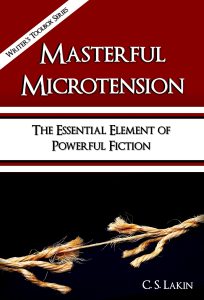 Learn how to masterfully craft microtension in your fiction. Microtension is the subtle but powerful element operating beneath the surface of a scene. It is created through contradiction, emotional friction, subtext, charged description, symbolism, and imaginative wordsmithing. When microtension is present, readers feel compelled to keep reading. When it’s missing, even well-plotted stories can feel flat.
Few writers have ever been taught about microtension in fiction and why it’s so important. And you’ll be hard-pressed to find any books, courses, videos, or articles on it. Yet … without it, your fiction can fall flat.
In Masterful Microtension: The Essential Element of Powerful Fiction, you’ll study how skilled fiction writers create tension at the micro level using masterful techniques such as word pairings, literary devices, motifs, and polarities.
Most books on fiction writing focus on structure, character arcs, and dramatic conflict. While those elements are crucial to a great story, they only address the big-picture elements. Microtension works at the word level, shaping the emotional energy between narrative, actions, and thoughts.
Regardless of what genre you write, Mastering Microtension will magnificently transform your prose. If you want to elevate your fiction from competent to compelling, from readable to unforgettable, microtension is the key.
Get your copy (ebook or paperback) on Amazon or any other outlet online!
The post Master Microtension by Studying Masterful Writers appeared first on C. S. Lakin.