4 months ago
17
4 months ago
17
How long does it take to write a book, you ask? If you’re a first-time author, you probably think it takes a LONG time.
Thankfully, we have some good news for you…
Writing a book can take far less time than you might imagine! But how long does it take to write a book?
If you dream of writing a book, but worry about the time it will take to make your dream come true, you’re not alone.
Before you commit to making your book idea a reality, you need to know how long it takes to write a book.
If you’re looking to write a brilliant book in a short amount of time that fits your lifestyle, we’ve got you covered.
This guide gives you the real numbers. Average timelines, word count benchmarks, session math, and the specific tactics that compress months off your schedule without hurting quality. By the end, you’ll know exactly how long it takes to write a book like yours, and you’ll have a deadline you can actually hit.
TL;DR
How long does it take to write a book? The average author finishes a full book in 4–8 months, with 6 months (about 180 days) being the most common timeline. A 50,000-word book takes roughly 100 writing sessions at 500 words per session, or 50 sessions at 1,000 words. Factor in editing (2–3 months) and launch prep (2–3 months), and the full write-to-publish timeline typically runs 8–12 months. That said, many of our authors finish much faster with our guidance.
How long does it take to write a book on average?
The average author finishes a book in 4–8 months, with 6 months (180 days) being the most common timeline for a 50,000–80,000 word manuscript. That’s writing only. Editing and publishing add several more months.
Your actual timeline depends on four variables:
- Genre and target word count. A 40,000-word self-help book moves faster than a 100,000-word epic fantasy.
- Your writing speed. Most authors produce 500–1,000 quality words per session.
- Session frequency. Writing 3x per week vs. 5x per week cuts the timeline nearly in half.
- How much revision you build in. Planning heavy, revising light beats the reverse every time.
If you’re still at the ideation stage, our guide on where to start when you want to write a book is the right next step before you commit to a deadline.
How long does it take to write a book for first-time authors?
First-time authors typically need 6–12 months to write their first book. The extra runway accounts for the learning curve of building a writing habit, finding your voice, and working through the inevitable middle-of-the-book slump.
Here’s how to set a realistic first-book deadline:
Step 1: Establish your writing speed
Write 500 words under conditions similar to your real writing environment (same time of day, same distractions, same tools). Time it. Repeat on three different days and average the results. That’s your baseline. Don’t compare it to anyone else’s.
Step 2: Survey authors you know
If you know anyone who’s written a book in your genre, ask them how long it took and what they’d do differently. Get three data points if you can. The patterns that emerge are usually more useful than any published “average.”
Step 3: Audit your calendar honestly
Before locking in a deadline, look at the next 6 months on your calendar. Vacations, work deadlines, family commitments, moves… subtract those weeks from your writing runway before you promise yourself anything.
Step 4: Add a buffer
Whatever timeline you land on, add 20%. First drafts almost always take longer than planned, and a missed deadline hurts motivation more than a conservative one.
Once you have your first book under your belt, you’ll write the second one faster. Often 30–50% faster. The first book is partly a book and partly a training ground.
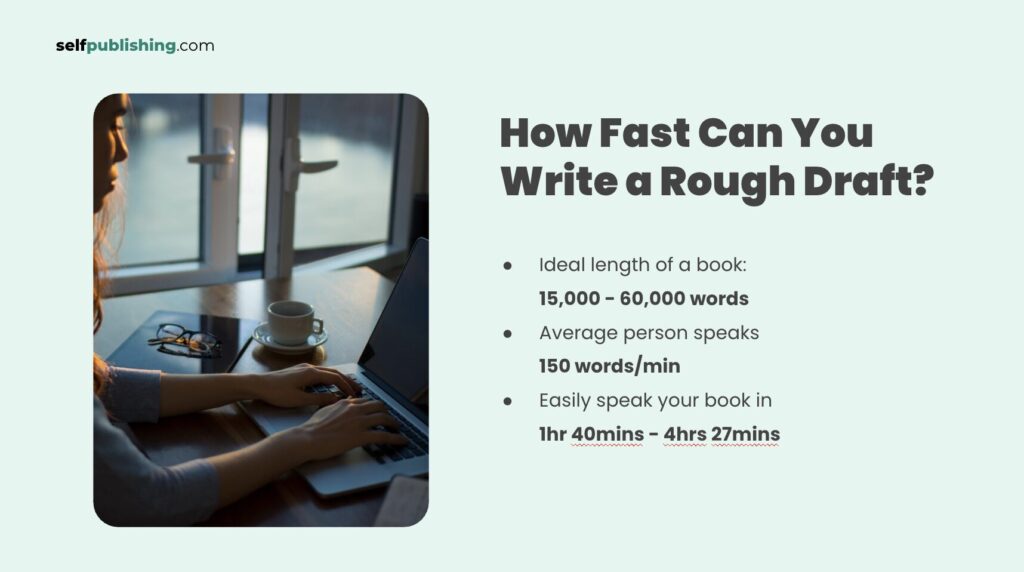
How to schedule a deadline for writing your book
Even though writing the content for your book is only one part of the self-publishing process, it’s the most important part!
You can create the most beautiful book cover in the world and come up with a persuasive book marketing plan. However, if the writing itself is anything less than stellar, your readers will feel disappointed.
Of course, it’s not enough to write well. You also need to write according to a realistic timeframe.
Why, exactly?
As a self-published author, shouldn’t you have the luxury of taking as long as you please?
While you have the liberty to write according to any schedule you want, you should take the time to establish an optimal one.
Some of the main benefits of setting a book writing deadline include:
- Momentum. For many authors, enthusiasm for writing their book tapers off over time. If you take too long to get it done, you run the risk of losing your momentum and abandoning the project altogether. Setting an achievable book writing deadline keeps you motivated to see it through.
- Project planning. If you’re self-publishing properly, you have a long checklist of tasks to carry out aside from writing. To launch and market your book, you need to know when it will be complete.
- Author wellness. Failing to set a deadline is a fast way to feel overwhelmed and unfocused. A book writing deadline allows you to set manageable targets and to remain in control at all times.
But what should your writing deadline be?
If you’ve written a book in the past, you’ll have a realistic idea of how long it takes to write a book. Even then, it’s worth keeping in mind that different books take different amounts of time to write.
How many pages does it take to write a book?
Perhaps you prefer to think in terms of page count rather than word count.
While measuring progress by the number of pages written was more common in the days of the typewriter, as it was a lot easier to track pages than words, it’s still a metric that’s easy to visualize. It’s also how we measure our progress as readers.
To plan how long it takes to write a book from a page count perspective, you need to work with the understanding that:
500 words typically equals about a page and a half.
This is affected by your typesetting and the visual content of your book, but it’s a good guideline.
Using the 500 words per page and a half metric, different books have the following average page counts.
Example fiction book page counts
- An 80,000-word mainstream romance novel has around 240 pages
- A 90,000-word historical fiction book has around 270 pages
- A 100,000-word sci-fi or fantasy book has around 300 pages
Example non-fiction book page counts
- A 40,000-word self-help book has around 120 pages
- A 70,000-word business book has around 210 pages
- A 150,000-word biography has around 450 pages
Of course, you don’t have to be constrained by these page counts when writing your book, but it’s good to be aware of what readers might expect.
But what about if your book isn’t one of the above book genres?
Here’s a method to find the average page count for any type of book:
- Go to Amazon‘s online bookstore
- Search for the genre of book you are writing
- Open up the Kindle Edition book pages of the top 10 current bestsellers within your chosen category
- Scroll down until you see the Print Length information for each book
- Average out the number of pages
- Calculate how many words you will need to reach that page count
By following the above steps you give yourself the peace of mind of knowing how long similar books to yours are, so your readers’ expectations are met.
Here’s how word count translates to page count across common genres:
Fiction page counts by genre
| Romance | 70,000–90,000 | 210–270 |
| Mystery / thriller | 70,000–90,000 | 210–270 |
| Historical fiction | 80,000–100,000 | 240–300 |
| Sci-fi / fantasy | 90,000–120,000 | 270–360 |
| Young adult | 50,000–80,000 | 150–240 |
Nonfiction page counts by category
| Self-help | 40,000–60,000 | 120–180 |
| Business | 50,000–70,000 | 150–210 |
| Memoir | 70,000–90,000 | 210–270 |
| Biography | 100,000–150,000 | 300–450 |
How long does it take to write a book based on writing speed?
At 500 words per session, a 50,000-word book takes 100 sessions. At 1,000 words per session, it takes 50 sessions. Translating sessions to calendar time depends entirely on how often you write.
Here’s what that looks like in practice:
| 500 words | ~8 months | ~5 months |
| 1,000 words | ~4 months | ~2.5 months |
| 2,000 words | ~2 months | ~1.5 months |
Most authors underestimate session frequency and overestimate session output. A sustainable 500 words, five days a week, beats a heroic 3,000-word Sunday marathon every time — because marathon sessions burn out, and consistency compounds.
If 500 words per session feels slow, the fix isn’t grinding harder. It’s usually a planning problem. Writers with a solid outline almost always hit higher words-per-hour than writers staring at a blank page. Our book outline guide walks through the exact structure.
How long does it take to write a book and publish it?
Writing a book takes 4–8 months on average, and the full write-to-publish timeline typically runs 8–12 months when you include editing and launch. Self-publishing is significantly faster than traditional publishing, which can take 18–36 months after the manuscript is complete.
Here’s the full timeline broken into phases:
| Planning and outlining | 2–4 weeks |
| First draft | 3–6 months |
| Self-editing and revision | 1–2 months |
| Professional editing | 1–2 months |
| Cover design and formatting | 2–4 weeks |
| Launch prep and marketing setup | 1–2 months |
| Total (self-publishing) | 8–12 months |
Our full guide on how to publish a book in 9 steps covers everything after the manuscript is done. If you want the complete writing walkthrough from idea to final draft, the how to write a book pillar guide is the definitive resource.
How to speed up the book writing process
Taking longer to write doesn’t necessarily result in a better book.
In fact, it’s often the opposite. By taking too long, your initial idea loses its luster, your enthusiasm wanes, and your content becomes dull and dated.
If you want to write a book faster, here are some quick tips to hasten your process:
- Schedule more writing time. How much time do you waste on social media? On Netflix? On anything that isn’t aligned with your goals? Many authors can find extra time to write when they take a look at their schedule.
- Improve your planning process. Regardless of whether you’re writing fiction or nonfiction, you’ll do it a lot faster if you plan properly. Consider whether improving your research or outlining process could help you reach your deadline sooner.
- Leverage the power of community. If you’re the only person who knows about your book writing deadline, it’s easy to let it slip. Partnering with a fellow author to motivate each other, or even letting a loved one know about your goal, can be an invaluable way to stay on track.
- Apply external pressure. Sometimes setting consequences can help you write a book in less time. A service like Stickk might be worth checking out, or you could pre-pay for marketing or publication services that require your book to be ready by a certain time.
Only use this technique if you have the type of personality that wouldn’t be panicked or overwhelmed by external pressure! - Optimize your writing conditions. Writing a book in the shortest time possible isn’t an act of magic or luck. We can influence various factors to speed up our output. When you find your favorite place to write, tool to write with, and most productive time of day, you are likely to finish your book faster.
While it’s a great idea to finish your book as soon as you can, you shouldn’t sacrifice its quality.
Striking a balance between speed and excellence is an important part of your growth as a writer.
Writing as fast as possible might seem tempting, but be aware that rushing your work will require more time for editing and improvement further down the line, increasing the overall time taken.
Tools to boost your writing speed
As contemporary writers, we’re blessed with a range of tools and technology to help us speed up our book-writing process.
If you’re looking for an extra edge to help you finish your book faster, consider using a tool!
Here are some tools to write your book faster:
- Specialist writing software. Have you ever considered that your choice of book-writing software might be slowing you down? Selecting a specialist option suited to books in general, or novels in particular, might give you extra features that boost your output.
- A second screen. Do you lose time by switching back and forth between your word processor and your research or notes? If so, consider investing in a second monitor so you can have both on display at all times.
- Dictation apps and tools. Some people prefer to speak their book than to type it. You might also get physically tired of typing but be able to carry on through dictation. Experiment with dictation to see if it gives you a productivity boost.
- A new keyboard. If you’ve written on several different computers, you’ll know that your choice of keyboard can impact your writing speed.
- White noise or music. What you listen to while writing, if anything at all, is very much a personal preference. Try experimenting with different types of white noise and music to see if you notice a difference in your rate of output.
If you’re struggling to write at the speed you want, give some of the above tools a try.
They might just cut down on the time you need to make your book a reality.


So, how long does it take to write a book? It depends on your schedule, motivation, writing tools, genre, word count, and more. On top of that, you should also factor in the publishing process, after all how long it takes to write a book and publish it is longer than the writing process itself!
Common mistakes that make writing a book take longer
Most authors don’t fail because they can’t write. They fail because they fall into one of these traps:
Starting without a deadline
“I’ll finish when I finish” is how books die. Without a deadline, there’s no forcing function, no urgency, and no measurable progress. Set a date, even an arbitrary one, and work backward.
Editing while drafting
Rewriting paragraph three before you’ve written paragraph four is the fastest way to lose a year. Draft messy. Edit later. They’re different modes and switching between them kills momentum.
Writing in the wrong order
You don’t have to write chapter one first. Most authors who finish write the chapters they’re most excited about first. It builds momentum and makes the slow chapters easier when you get to them.
Choosing the wrong word count
A bloated manuscript takes twice as long to write and twice as long to edit. Research your genre’s word count expectations before you start, not after.
Ignoring the rough draft principle
First drafts are supposed to be bad. Authors who accept this finish in months. Authors who don’t spend years polishing chapter one.
FAQ: How long does it take to write a book?
Can you write a book in 30 days?
Yes. NaNoWriMo has historically proven that every November. Writers hit 50,000 words in 30 days by committing to 1,667 words per day. It’s intense but achievable if your calendar is clear and your outline is solid. Expect the rough draft to need significant revision afterward.
How long does it take to write a book of 50,000 words?
At 500 words per session writing 5 days per week, a 50,000-word book takes about 5 months to draft. At 1,000 words per session, it takes about 2.5 months. Add 1–2 months for editing before publishing.
How long does it take to write a 300-page book?
A 300-page book is roughly 90,000–100,000 words. At a typical pace of 1,000 words per session writing 5 days per week, the first draft takes 4–5 months. Editing and revision add another 2–3 months.
How long did famous authors take to write their books?
Timelines vary wildly. Stephen King writes a first draft in 3 months. J.K. Rowling spent 6 years on the first Harry Potter. George R.R. Martin famously takes 5+ years per book. Your timeline depends on your genre, your schedule, and your process, not on what worked for someone else.
How long does it take to write a book and get it published through self-publishing?
Expect 8–12 months total: 4–8 months to write, 1–2 months to edit, and 2–3 months for cover design, formatting, and launch prep. Self-publishing is dramatically faster than traditional publishing, which can add 18+ months on top.
Is it faster to write fiction or nonfiction?
Nonfiction is typically faster because the structure is predetermined and research happens before drafting. Fiction requires inventing plot, character, and world simultaneously which is slower but often more engaging for the author.
How much does it cost to write a book?
Writing is free; publishing isn’t. Most self-published authors spend $2,000–$10,000 on editing, cover design, and launch. Our full breakdown on how much it costs to publish a book covers every line item.
Your next step: start with a real deadline
Here’s the truth: how long it takes to write a book is almost entirely within your control. Pick your target word count. Calculate your session math. Block the time on your calendar. Start Monday.
There’s a reader out there whose life will change because of your book. Every week you delay is a week they don’t have it.
Ready to stop guessing and start writing? Our coaches have helped more than 7,000 authors publish their books – and most in under 12 months. If you want a proven system, accountability, and a clear path from blank page to bestseller, schedule a free strategy call with our team and we’ll build your timeline together.
The post How Long Does It Take To Write A Book? appeared first on selfpublishing.com : The #1 Resource For Self-Publishing a Book.